Investing in Real Estate Investment Trusts or REITs explained

IPOGMPTracker Team
2026-08-01 · 9 min read
Real Estate Investment Trusts own and manage real estate to earn rental income to distribute dividends. Read how to invest in REIT IPO, REIT benefits, taxation.
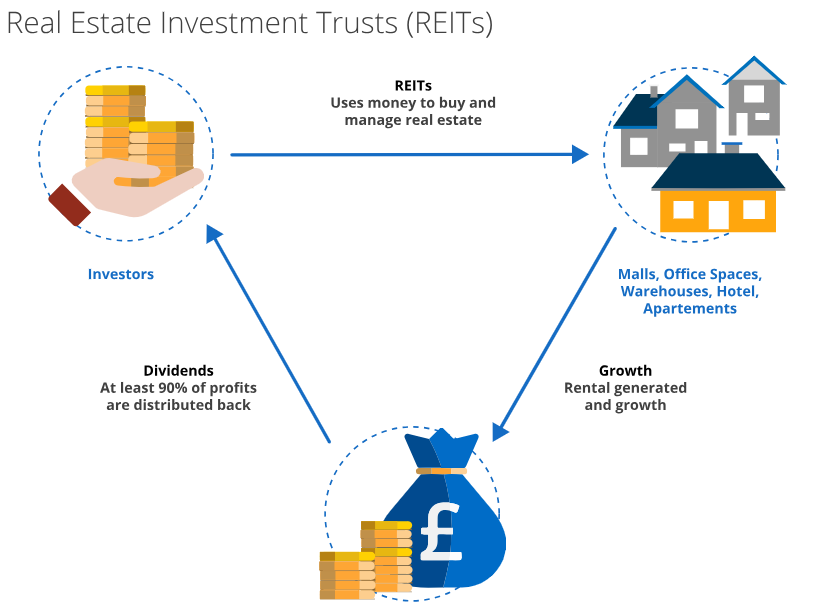
Real Estate Investment Trust (REIT) owns and/or manages real estate properties to generate income through capital appreciation and rental income. Similar to mutual funds, REITs collect money from many investors and invest it in income-producing real estate properties such as malls, office spaces, industrial parks, warehouses, etc. They lease or rent out properties and collect rental income in return, which in turn is distributed to investors as dividends.
REITs are an investment vehicle that allows retail investors to have proportionate ownership in yield-driving real estate assets. Therefore, individuals who wish to invest in real estate but do not have a large capital to purchase real estate properties can invest through REITs. All REITs in India are regulated by the SEBI Real Estate Investment Trust Regulations 2014.
Investors can invest in REITs by applying for the IPO or buying REIT units directly from the exchange, once the REIT is listed. As of May 2023, there are a total of 3 REITs listed in India. Embassy Office Parks REIT is the first listed REIT in India followed by Mindspace Business Parks REIT and Brookfield India REIT. Nexus Select Trust is India’s first retail REIT IPO.
If you want to invest in REIT IPO, read all about REITs including the types of REITs, the requirements for setting up a REIT, how REITs are taxed, and the pros and cons of REIT investment.
What is a Real Estate Investment Trust or REIT?
REITs or Real Estate Investment Trusts are companies that own, operate and manage income-driving real estate properties. The assets of REIT include industrial parks, shopping malls, hospitality, office buildings, warehouses, apartment complexes, resorts, data centers, healthcare facilities, retail centers, etc. REITs are the best investment option that offers investors the opportunity to invest in real estate assets to earn income in the form of dividends. In this way, investors enjoy capital appreciation while generating income.
REITs or Real Estate Investment Trusts are companies that own, operate and manage income-driving real estate properties. The assets of REIT include industrial parks, shopping malls, hospitality, office buildings, warehouses, apartment complexes, resorts, data centers, healthcare facilities, retail centers, etc.
REITs are the best investment option that offers investors the opportunity to invest in real estate assets to earn income in the form of dividends. In this way, investors enjoy capital appreciation while generating income.
There are 3 types of REITs that are popular in India, depending on the type of REIT business;
Equity REITs: These REITs invest in income-producing real estate properties. They generate income in the form of rental receipts which are distributed to shareholders.
Mortgage REITs: REITs that are primarily involved in the business of lending to real estate companies are called mortgage REITs. They provide money to property owners either directly in the form of mortgages or indirectly through mortgage-backed loans. mREITs earn income through mortgage payments or EMIs.
Hybrid REITs: As the name suggests, this form of REIT is a combination of equity and mortgage REITs. In other words, they own assets and also invest in mortgage-backed securities. Their revenue stream, therefore, includes both rental income and interest income.
Real Estate companies Vs REITs
Real estate companies and REITs are different because REITs acquire, develop and finance real estate properties as an investment portfolio, while real estate companies are primarily engaged in the development and resale of real estate assets. To establish a Real Estate Investment Trust, the real estate company becomes the REIT sponsor and must appoint a trustee to hold all assets in Trusteeship. Thus, the assets are under the direct control of the trust and not the sponsor. The REIT controls the real estate assets either directly or through the establishment of a special purpose vehicle (SPV), a domestic corporation that holds the real estate properties on behalf of REIT. According to the regulations, REIT must hold at least 50% stake in the SPV.
Real estate companies and REITs are different because REITs acquire, develop and finance real estate properties as an investment portfolio, while real estate companies are primarily engaged in the development and resale of real estate assets.
To establish a Real Estate Investment Trust, the real estate company becomes the REIT sponsor and must appoint a trustee to hold all assets in Trusteeship. Thus, the assets are under the direct control of the trust and not the sponsor. The REIT controls the real estate assets either directly or through the establishment of a special purpose vehicle (SPV), a domestic corporation that holds the real estate properties on behalf of REIT. According to the regulations, REIT must hold at least 50% stake in the SPV.
Eligibility or qualifying criteria to form a REIT
A real estate company that meets the following conditions set by SEBI is eligible to establish REIT;
REIT must distribute 90% of its taxable income as dividends to its shareholders or investors. The dividend distribution of a REIT is considered a tax deductible expense, therefore most REITs distribute 100% of their income as dividends to unitholders in order to have no tax liabilities.
At least 80% of REIT's assets should be invested in completed and leased rent or income-producing properties.
Minimum of 75% of gross income must come from rents or mortgage interest.
REITs can invest a maximum of 20% of their assets in cash, stocks, bonds, or real estate under construction.
The sponsor and the sponsor group should jointly own at least 25% of the REIT units for a period of 3 years from the date of listing REIT shares.
Once REITs are registered with the Security and Exchange Commission (SEC), they can go public through an Initial Public Offering (IPO). REIT IPO refers to the initial share sale offering of a REIT for public subscription. An IPO of REIT allows investors to invest in high-priced real estate properties.
REITs are permitted to launch IPO if the following conditions are satisfied;
The REIT is a SEBI registered REIT.
The total value of assets of REIT should not be less than Rs 500 crore.
REIT IPO issue or offer size should not be less than RS 250 crore.
One can invest in REIT by either applying for REIT IPO or investing through the stock exchange after the shares are listed.
Investors can easily park their money by applying for REIT IPO. To invest in the REIT IPO, it is mandatory to have a demat and trading account with any stock broker. You can place an IPO order during the period REIT is open for subscription. On July 30 2021, the market regulator SEBI reduced the minimum subscription size for REITs from Rs 50,000 to Rs 10,000 to 15,000.
Once shares of Real-Estate Investment Trusts are listed on the stock exchange, they will be publicly traded REIT. Other REITs that are registered with SEBI but have not yet issued shares in the market are referred to as unlisted or non-traded REIT.
Investing through the stock exchange
If you have not received the REIT share allotment, you can buy REIT units directly from the stock exchange after listing. The price of REIT shares fluctuates constantly depending on supply and demand.
Now the question arises as to how income from REIT IPO is taxed in the hands of investors Taxation at REIT works differently depending on the type of income, be it interest, dividend income, or capital gains.
Dividend Income: Income in the form of dividends from REIT is taxable for investors if the special purpose vehicle has opted for special tax relief. If this is not the case, there is no tax liability for investors.
If the underlying SPV has opted for a concessional tax regime under section 115BA, the dividend income will be treated as ordinary income. Thus, the dividend received will be added to the investor's income and taxed at the applicable tax rate.
If the underlying SPV has not opted for the tax benefit under Section 115BA, the dividend will be tax-free to the unitholders.
Interest Income: When a REIT receives interest payments and distributes them to unitholders, they are considered interest income to investors. Interest from REIT is taxable according to the applicable tax rate.
Capital Gains: Capital gains from the sale of REIT shares or units are subject to capital gains tax. There are two types of capital gains taxes imposed on REIT IPO;
Pros and Cons of Investment in REITs
Below are the main advantages and limitations/disadvantages of investing in real estate investment trusts;
REITs provide regular and consistent dividend income and long-term capital appreciation.
Investing in REITs helps diversify your portfolio and manage risk.
Since listed REITs are traded on the stock exchange, buying and selling REIT shares is easy and liquid.
Income from REITs such as dividends, interest, and capital gains are taxable for investors. Therefore, from a tax perspective, investing in REITs appears less attractive.
REITs are subject to the risk of market fluctuations in the real estate industry, which directly affect property values. Changes in tax and interest regulations also have a significant impact on REITs.
Since REITs distribute 90% of their income to investors and only 10% can be reinvested, growth prospects for capital appreciation are limited.
Frequently Asked Questions
What is the minimum investment amount in REIT?−
As per SEBI notification dated July 21, the minimum investment amount for REIT is between Rs 10,000 to Rs 15,000. Earlier, investors had to invest at least Rs 50,000 in REITs. The regulation has also reduced the minimum lot size for trading in REIT from 100 units to 1 unit.
How to buy REIT shares from stock market?+
Listed REITs can be traded on designated exchanges. Just like equity stocks, you can buy and sell REIT shares directly on the BSE and NSE exchanges. As per the SEBI’'s norms, investors can purchase even one unit of REIT shares from the stock exchange.
What are the risks in REIT investment?+
Investment in REIT is not risk-free and subject to the following risks;
Liquidity risk: Although public REIT units are traded on an exchange but it is comparatively less liquid than investment in other stocks and bonds.
Market risk: Financial market risks, changes in interest rates, and taxation norms directly affect the REIT returns. Further, it is vulnerable to real estate market trends and fluctuations.
What are the benefits of REIT investment in India?+
Investment in REITs brings the following advantages;
Helps in portfolio diversification
Easy entry and exit routes as listed REITs are tradable instruments on exchange.
Less risky than a direct investment in real estate properties
Comparatively more liquid than direct property investment
Regular dividend income as REITs has to distribute at least 90% of their earnings.
Affordable and cheaper alternative to invest in the real estate market as ticket size is low.
REITs are regulated by SEBI so the chances of fraud are low.
How REITs are registered?+
After the incorporation of REIT and the appointment of the manager and compliance officers, the sponsor can submit a registration application on the SEBI Intermediary Portal (SI Portal). REITs are required to pay a fee of Rs 1 Lakh while applying for registration. Once all the conditions for registration are fulfilled on REIT, SEBI will send an intimation through the SI portal. To obtain a registration certificate, the applicant has to pay a one-time registration fee of Rs 10 Lakh.
Compare Stock Brokers Comparison & Features
Advit Jewels IPO Review: GMP, Financial Performance & Valuation
A complete guide on how to apply in an IPO through UPI
Ways to increase the chance of getting IPO Allotment
A complete guide on IPO, FPO, OFS, and Rights Issue of Shares
How can HNIs apply for IPO and share allotment process
IPO GMP Meaning, How it works, Kostak Rates, Subject to Sauda
Investing in Real Estate Investment Trusts or REITs explained
Track it on IPOGMPTracker
IPO allotment status
Check your application by PAN or application number
Live IPO subscription
QIB, NII and retail bidding, updated through the day
Current IPOs
Every mainboard issue open for bidding right now
Upcoming IPOs
Issues with dates announced but bidding not yet open
IPO event calendar
Open, close, allotment and listing dates in one view
IPOGMPTracker home
Live GMP across mainboard and SME IPOs